WTF is an LLM, Agentic Workflow, and AI Agent?
AI is full of buzzwords right now — LLM, Agents, Agentic AI, Autonomous Systems. If you're building things or just exploring the space, it can feel overwhelming.
In this post, we'll break down three core concepts that power most modern AI systems — simply, practically, and with real-world examples so you can actually tell them apart.
The Three Concepts at a Glance
1. LLM — Large Language Model
An LLM is essentially a text prediction machine.
It reads your prompt and predicts the most probable next words. That's it.
- ❌ No decisions
- ❌ No tools
- ❌ No autonomy
Just generate text based on context.
How it works
User Prompt → LLM → Response
Example
You ask: "Write a Python function to sort an array."
The LLM replies with code — but it does not run it, test it, or fix errors. It simply generates text.
Analogy
📚 Think of an LLM as a very smart librarian who answers questions but never leaves the desk.
2. Agentic Workflow
Now imagine connecting multiple LLM calls together in a predefined process. That's an Agentic Workflow.
Here, humans define the steps — the LLM just performs each one. The workflow is fixed.
Example
You want to auto-generate a blog post. The workflow might be:
- Research the topic
- Extract key points
- Write a draft
- Polish the writing
User Request
    ↓
Research the topic (LLM1)
    ↓
Extract key points (LLM2)
    ↓
 Write a draft (LLM3)
    ↓
Polish the writing (LLM4)
    ↓
Final Output
Each step calls an LLM — but the system doesn't decide what to do next. You already defined the pipeline.
Analogy
🍝 Think of it as following a cooking recipe — boil water, add pasta, add sauce. Fixed steps, no creativity, just execution.
3. AI Agent 🧠
Now things get interesting, AI Agent reAct i.e Reasoning and Actions.
An AI Agent is a system that can decide what actions to take. Instead of following fixed steps, it runs a reasoning loop — thinking, acting, observing, and adapting until the job is done.
The agent loop
Thought → Action → Observation → Repeat
How it works
User Request
    ↓
LLM Reasoning
    ↓
Choose Tool  (Search / Code / Database / ...)
    ↓
Execute Tool
    ↓
Observe Result
    ↓
Repeat until task is complete
💡 Point to remember : AI Agents have access to tools and they decide which tool is more sutiable to complete current task
Example
You ask: "Find the best laptop under $1,500 and compare performance."
The agent figures out its own steps:
- Search for laptops in that price range
- Extract specs from results
- Fetch benchmark scores
- Compare performance metrics
- Generate a final report
The workflow was never predefined. The agent figured it out itself.
Analogy
👨🍳 Think of it as a professional chef. You say "cook me a great dinner" — the chef decides the dish, the ingredients, and how to prepare it. That's autonomous.
Why Most Companies Don't Use Full Agents Yet
Fully autonomous agents are exciting, but they come with real tradeoffs:
- 💸 Expensive — each loop can trigger multiple LLM calls
- 🎛️ Hard to control — difficult to constrain or audit behavior
- 🎲 Unpredictable — can take unexpected paths to complete tasks
So most production systems today sit somewhere in between:
LLM + Agentic Workflow = Reliability + Control
📍 Summary
Think of these as levels of intelligence and autonomy:
LLM → Agentic Workflow → AI Agent
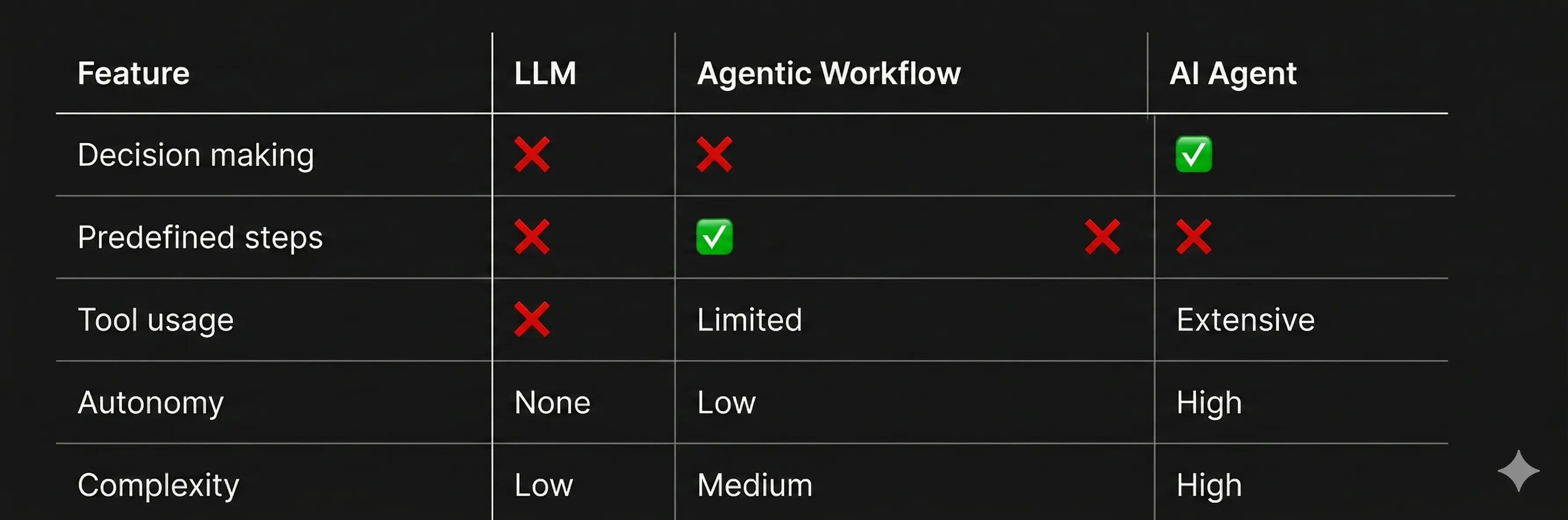
Understanding this difference won't just help you talk about AI — it'll help you design better systems instead of just calling APIs blindly.