Part 1: The Universe Has a Very Long Memory
Okay so here's the thing. Dinosaurs went extinct roughly 66 million years ago. That's a number so large it basically stops meaning anything to our monkey brains. For reference, humans have only been around for about 300,000 years. We are babies compared to how long dinosaurs roamed this planet.
But here's where it gets interesting.
When anything happens — a T-Rex roaring, a meteor hitting, literally anything — that event emits light. Light bounces off surfaces, carries visual information, and then just... keeps going. Forever. Into space. At 300,000 km per second.
So all those events from 66 million years ago? That light has been travelling through space ever since. It didn't stop. It didn't pause. It's been silently cruising through the cosmos this whole time, carrying a snapshot of a world we'll never get to see.
Now here's the mind-bending part: if there's a planet 66 million light-years away from Earth, and there are aliens on it with a powerful enough telescope pointed at us — they are watching dinosaurs right now. Not fossils. Not bones in a museum. They're watching the actual, living, breathing, absolutely terrifying creatures just casually existing on Earth.
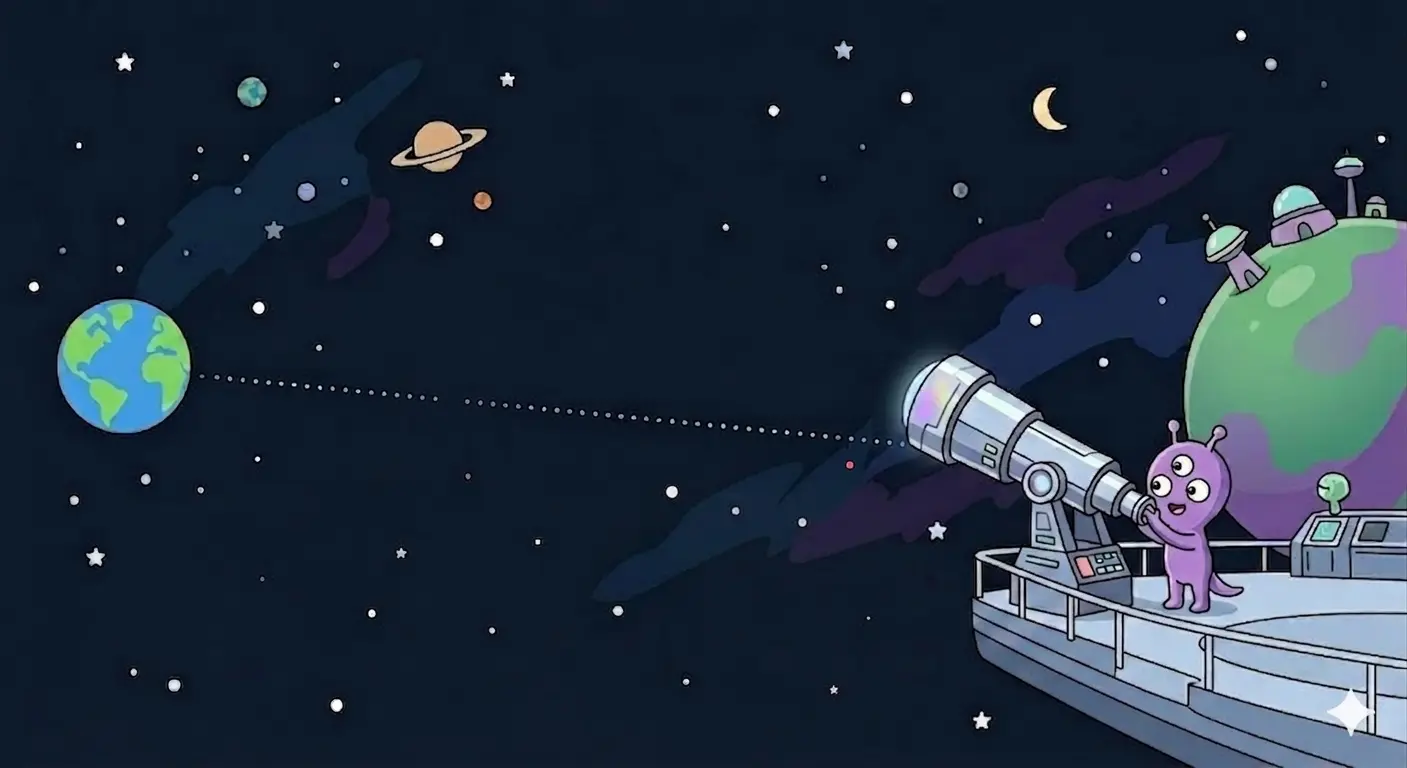
They have no idea what a human is. We haven't shown up in their feed yet.
Think about that for a second. We exist on a cosmic timeline where different parts of our story are playing out simultaneously for different observers across the universe. An alien 100 light-years away sees Earth as it was in 1926. One 1000 light-years away sees medieval times. The further out you go, the further back in time you're seeing.
The universe isn't just big. It's a time capsule — and everyone's looking at a different chapter of the same book.
This also means Earth is constantly broadcasting its entire history outward into space at the speed of light. Every war, every sunset, every species that ever lived — all of it is encoded in light waves silently streaming outward in every direction. We're a leaky hard drive. The universe already has our backup.
Part 2: What If We Wanted to See the Dinosaurs?
Alright so naturally, my next thought was — okay cool, aliens can see our past. But what if I want to? What if I want to actually watch a T-Rex stomp around? Is there any way to catch that light that left Earth 66 million years ago?
Technically yes. Conceptually terrifying. Physically impossible. Let me explain.
That ancient light is currently somewhere around 66 million light-years away from Earth. To see it, you'd need to physically travel out there, turn around, point your telescope back at Earth, and observe. Simple enough plan, right?
There's just one tiny problem.
You'd need to travel faster than light.
Not a little faster. You'd need to overtake light that's been running at full speed for 66 million years. That light has a 66 million light-year head start on you. To catch up, you'd need to exceed the one speed limit the universe actually enforces — and unlike traffic cops, the universe doesn't let you off with a warning.
Why Can't We Go Faster Than Light?
Here's where Einstein crashes the party and ruins everything (respectfully).
According to Special Relativity, the speed of light in a vacuum — roughly 299,792,458 m/s — is not just a speed. It's a fundamental constant of the universe. It's the maximum speed at which anything can travel. And the reason comes down to something pretty wild: mass and energy.
The faster you move, the more energy you need. Fine. But here's the cruel joke — as you accelerate toward the speed of light, your relativistic mass increases. The closer you get to c (speed of light), the more energy it takes to accelerate further. And as you approach c, the energy required approaches... infinity.
You'd need infinite energy to reach the speed of light. And you'd need more than infinite energy to exceed it. The universe just laughs and says no.
"Nothing with mass can reach the speed of light. You'd run out of universe's energy budget long before you got there."
— Einstein, paraphrased, probably while smirking.
The only things that can travel at the speed of light are massless particles — like photons (particles of light). Photons don't have mass, so they're not subject to that energy penalty. They just... zip along at c because that's what they do. It's literally their whole personality.
We, unfortunately, have mass. Quite a lot of it if you've been stress-eating lately. So we're stuck.
What Happens If You Try Anyway?
Let's say hypothetically you're in a spaceship and you keep accelerating. As you approach the speed of light, according to Special Relativity:
- Time slows down for you (time dilation) — you'd age slower than people back on Earth
- Your length contracts in the direction of motion (length contraction)
- Your effective mass increases — requiring exponentially more energy to push you further
At 99% the speed of light, time for you passes about 7x slower than for people on Earth. At 99.9%, it's about 22x slower. You could theoretically travel large distances in your subjective lifetime — but you'd never actually reach c, and you'd certainly never exceed it.
The universe has a speed limit and it's non-negotiable. No exceptions. No loopholes. No premium subscription tier that unlocks faster-than-light travel. (Trust me, I checked.)
So… We'll Never See the Dinosaurs?
Not directly. The light carrying that information is gone, racing away from us at c, and we can never catch it.
What we can do is dig up fossils, run carbon dating, reconstruct skeletons, and build increasingly accurate simulations of what those creatures looked like. Scientists have gotten genuinely impressive at this — we now know many dinosaurs had feathers, that T-Rex probably couldn't run as fast as Jurassic Park suggested, and that some of them were actually kind of small and weird-looking.
But actually watching them? Seeing a real Triceratops through a telescope?
That privilege belongs to a civilization 66 million light-years away — if one exists, and if they're looking in our direction with gear powerful enough to resolve a single planet around a unremarkable star in a galaxy they probably don't even have a name for.
There's something humbling about that. Our entire history — every living thing that ever existed on this planet — is silently broadcasting outward into a universe that mostly doesn't know we're here. And the one chapter that would blow every alien mind — the age of dinosaurs — is currently playing out for an audience we'll never meet, on a screen we'll never find.
We're not watching the past. The past is leaving us behind.